CivilWarArtillery.com
How Artillery Fuzes Worked
Civil War artillery fuzes, just like the projectiles, came in many different sizes, shapes, and varieties. While the primary purpose of the fuze was to explode the projectile among enemy forces, the methods used to accomplish this objective varied. In many cases, the artillerist was the one who decided what type of fuzing system to employ based on the range of the target, type of target, and type of projectile he intended to use. In other cases, the artillerist made the choice of projectiles and had to use the fuzing system manufactured into the projectile.
All fuzing systems can be broken down into four categories: Time, Percussion, Combination, and Concussion.
(1) TIME
This time system was most employed fuze system. Time fuzes were designed to explode a projectile after a predetermined number of seconds. Two basic systems of time fuzes were used. The first system was simply a powder composition, wrapped tightly in paper and pre-cut at the factory to determine the time before explosion. It was driven into a metal or wood fuze plug mounted in the fuze hole of the projectile. The second system employed a soft metal housing containing a powder train. The artillerist would cut through the train at the appropriate time mark before loading the projectile into the cannon.
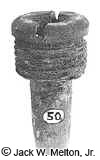 Both time
fuze systems relied on the flame from the exploding propellant charge in the
cannon tube to ignite the powder composition. After the composition had
Both time
fuze systems relied on the flame from the exploding propellant charge in the
cannon tube to ignite the powder composition. After the composition had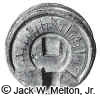 burned down
through the set number of seconds, the fuze flame would enter the powder chamber inside
the projectile and cause the projectile to explode.
burned down
through the set number of seconds, the fuze flame would enter the powder chamber inside
the projectile and cause the projectile to explode.
The most common projectiles found which employed the time fuze system are Parrott, Hotchkiss, and Bormann-fuzed spherical shells.
(2) PERCUSSION
Percussion was the second most employed
fuze system. These were designed to explode the
projectile when the fuze made contact with an object. Most percussion fuzes employed a
plunger-and-anvil method of detonation. The fuze body was usually brass, copper, or alloy,
and was threaded so that it could be screwed into the nose of the projectile. When the
fuze struck an object, a striker would slide forward down a chamber inside the
fuze body
and strike a percussion cap
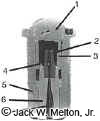 (which was seated on a nipple) against the anvil. Employing
the same principle as a musket, the percussion cap then exploded, sending a small flame
through a hole in the nipple and igniting a powder train. The powder train transferred the
flame to the powder chamber and detonated the projectile.
(which was seated on a nipple) against the anvil. Employing
the same principle as a musket, the percussion cap then exploded, sending a small flame
through a hole in the nipple and igniting a powder train. The powder train transferred the
flame to the powder chamber and detonated the projectile.
The common projectiles that employed the percussion fuze system are Parrott, Hotchkiss, Schenkl, and James.
(3) COMBINATION
As the name implies, this system was a combination of the time
fuze and percussion fuze
systems. Combination fuzes varied widely in their method of detonation depending upon the
inventor and manufacturer. The basic premise was that the fuze was set prior to firing to
a specific detonation time. When the projectile was fired from the cannon tube, the shock
(or inertia)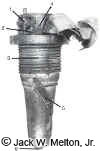 of the firing caused a plunger to slide down and strike a chemical
composition against a metal platform, causing a flame to ignite the powder train. If the
projectile struck an object before the time element was completed, the system was designed
to activate as a percussion fuze.
of the firing caused a plunger to slide down and strike a chemical
composition against a metal platform, causing a flame to ignite the powder train. If the
projectile struck an object before the time element was completed, the system was designed
to activate as a percussion fuze.
Combination fuze systems can be found on Armstrong, Schenkl, and Sawyer projectiles, among others.
(4) CONCUSSION
These fuzes were designed to activate from the shock of striking an object. Once again, the actual mechanics of the fuze system varied according to the manufacturer and inventor. Some systems employed chemical vials which, when shattered upon impact, caused a fire inside the fuze body and transferred to the powder chamber. Other systems relied upon plaster to separate the igniting material from the powder until the plaster shattered upon impact.
WARNING: Chemical concussion fuzes, especially the Tice concussion fuze, should be avoided by collectors unless it is known beyond any doubt that the vials have already been destroyed.
Many projectiles found in the field still retain their fuzing system. There are many reasons for the failure of a fuze system to detonate, but the most common explanations are that the fuze was damaged while being set into the projectile (by either the manufacturer or the artillerist), the fuze was damaged upon impact, or, as in the case of a percussion system, the projectile tumbled as it traveled and landed without the fuze striking anything. Many projectiles recovered from battlefields indicate that the fuze worked properly but the projectile was defective.
The fuze illustrations that follow are not meant to be inclusive or comprehensive with respects to all classes and examples, but rather to give the reader an overview of this fascinating area of study.